You've set ambitious goals, but why aren't the results skyrocketing?

The brutal truth is that most organizations are great at planning but terrible at execution. The gap between a beautifully crafted Objective and Key Result (OKR) and a successfully achieved one is where strategies go to die.
This is the domain of OKR Execution the critical, often-misunderstood engine that transforms ambition into tangible outcomes. If your company’s goals consistently miss the mark, the problem isn't likely your strategy; it's your OKR Implementation
The Execution Gap: Why Your Brilliant OKRs Are Not Delivering
It’s a silent epidemic in boardrooms worldwide.
Teams spend quarters in planning meetings, crafting perfect-sounding Objectives. Yet, when the quarter ends, the same frustrating conversation happens: "We got busy," or "Priorities shifted." This failure is rarely about intent. It's about a flawed system.
Studies suggest that a staggering 70% of organizational change programs, including new goal-setting frameworks, fail. Not because the ideas were bad, but because the execution was poor. Understanding this "why" is the first step toward fixing it. Let's dissect the common culprits that derail OKR implementation before it even gains momentum.
Why Does OKR Execution Fail in Organizations?
Why does this happen so often? The reasons are rarely complex, but they are pervasive.
Set and Forget Mentality: Leaders announce the OKRs for the quarter and then never speak of them again. The document sits in a slide deck, gathering digital dust until the next review cycle. Without constant conversation, OKRs become irrelevant noise.
Lack of True Ownership: When everyone is responsible, no one is accountable. If a Key Result doesn't have a single, named owner who feels its success or failure personally, it will inevitably drift.
Treating OKRs as a Task List: This is a classic error. Teams simply copy their tasks into the OKR format. Instead of inspiring stretch goals, this creates a checklist that lacks ambition and strategic alignment.
Fear of Failure: If missing a stretch goal results in punishment or blame, teams will sandbag. They will set easily achievable "safe" goals, completely defeating the purpose of the OKR framework, which is designed to push boundaries.
The High-Performer's OKR Execution: An Unbeatable Framework
What fundamentally distinguishes the top-performing organizations?
So, how do the top 10% of companies do it differently? They don't just set OKRs; they live them. They have a disciplined, repeatable OKR execution framework that turns goals into a weekly, even daily, practice.
This isn't magic; it's a system. And it's built on a foundation of rhythm, transparency, and adaptability.
Phase 1: The Strategic OKR Rollout
A successful OKR rollout begins long before the first goal is written. It starts with alignment and education.
Secure Leadership Buy-In and Model Behavior
The entire OKR deployment hinges on leadership. Executives must not only endorse the process but actively participate. They must write their own OKRs transparently, share them with the company, and be the first to report on progress. When the CEO openly tracks and discusses their Key Results, it signals that this is a priority, not just another HR initiative.
Communicate the "Why" Relentlessly
People don't resist change; they resist being changed. Before diving into the "how," explain the "why." Why are we moving to OKRs? Is it to improve focus, increase alignment, or accelerate growth? Connect the OKR system implementation to a larger purpose that every employee can understand and support.
Phase 2: The Engine of Effective OKR Execution
This is where the real work happens. This phase is the continuous cycle that powers effective OKR execution.
Weekly Check-Ins: The Pulse of Progress
High-performing teams replace the dreaded monthly status meeting with a fast, focused weekly check-in. This 20-30 minute meeting is not for problem-solving in depth. It's for answering four simple questions:
What did we accomplish last week related to our Key Results?
What are we planning to accomplish this week?
What are our blockers or risks?
What is the confidence level for each Key Result (on a scale of 1-10)?
This ritual creates a rhythm of accountability and keeps goals top-of-mind. It’s the single most powerful habit for OKR process optimization.
Score and Reflect with Courage
At the end of the cycle, the work isn't over. Teams must score their OKRs and, more importantly, reflect on the outcome. A low score isn't a failure; it's a data point. The critical activity is the retrospective discussion: "Why did we score a 0.6? What did we learn? What would we do differently next time?" This transforms execution into a learning engine.
Phase 3: Leveraging Technology for OKR Process Optimization
While a spreadsheet can work for a small team, it quickly becomes a liability. For organization-wide OKR performance management, the right OKR software is a game-changer.
How OKR Software Enhances Execution
The right tool does more than just store goals. It creates a system of record that:
Creates Radical Transparency: Everyone can see everyone else's OKRs, breaking down silos and fostering cross-team alignment.
Automates the Rhythm: It sends reminders for check-ins, tracks confidence levels, and automates scoring.
Provides Real-Time Visibility: Leaders get a live dashboard of organizational health, spotting risks and opportunities early.
Connects Day-to-Day Work: Integrating with tools like Jira, Slack, or Asana connects daily tasks to strategic Key Results, showing how work ladders up.
Choosing to invest in OKR software is a signal that you are serious about OKR execution.
Common Mistakes in OKR Implementation (And How to Fix Them)
Even with a framework, teams stumble. Here’s how to fix the most common OKR execution problems.
Mistake 1: Cascading vs. Aligning
Many companies "cascade" OKRs, meaning leadership sets them, and then each department copies them down the chain. This creates a rigid, top-down hierarchy. The fix? Shift from cascading to aligning. Leadership sets the company OKRs
Teams then create their own OKRs that explicitly show how they will contribute to the company-level goals. This empowers teams and sparks innovation.
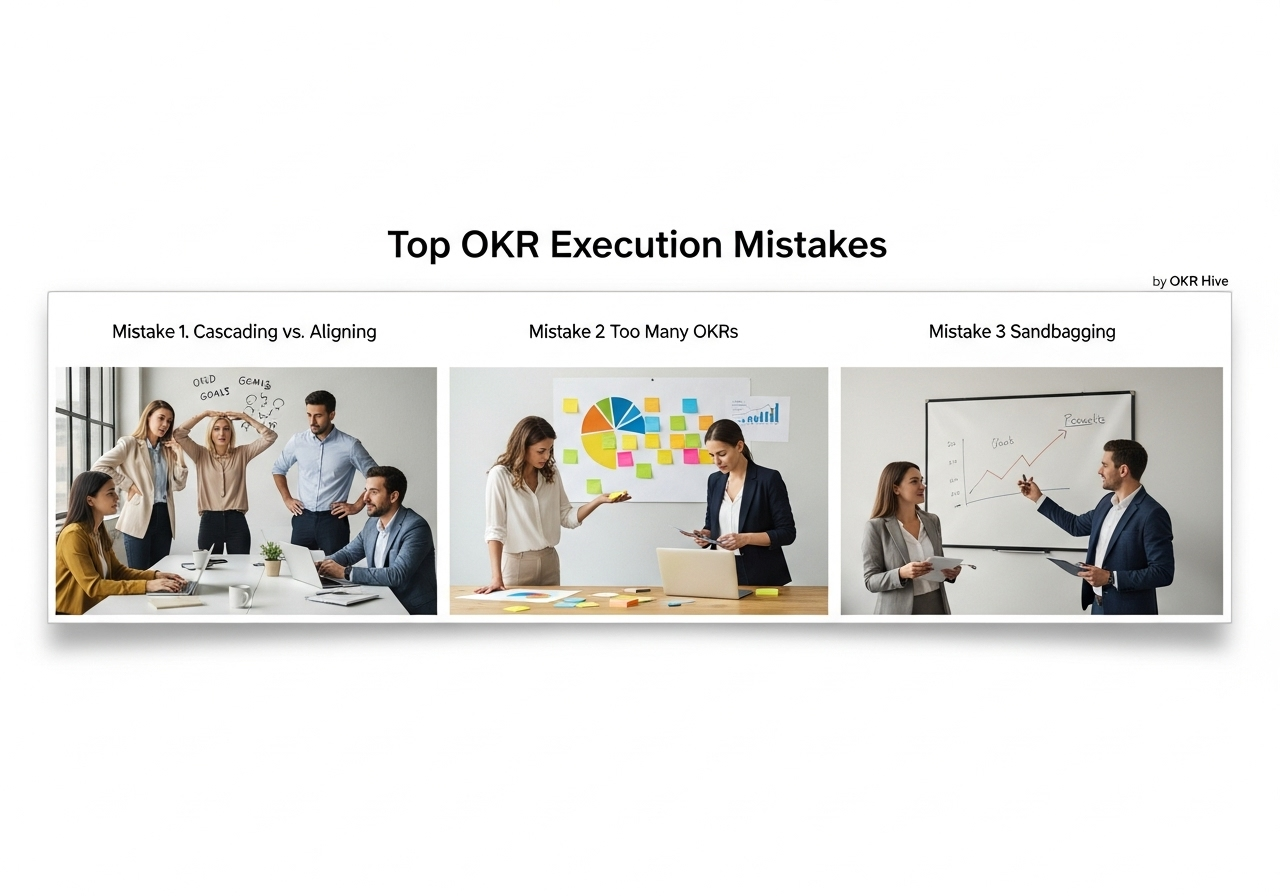
Mistake 2: Too Many OKRs
Ambition is good, but focus is better. If a team has 5 Objectives and 15 Key Results, they have nothing. The OKR best practice is 3-5 Objectives per team, with 2-5 Key Results each. This forces ruthless prioritization, which is the cornerstone of effective OKR implementation
Mistake 3: Sandbagging
When teams set goals they know they can easily hit, the system fails. The fix is cultural: leaders must celebrate ambitious attempts, even those that end in a score of 0.6 or 0.7. Reframe a "failed" stretch goal as a learning milestone. This psychological safety is non-negotiable.
Your Action Plan: Steps to Enhance OKR Deployment Success Rate
Ready to stop planning and start executing? Here is your proven OKR rollout process for teams.
Audit & Educate: Honestly assess your last failed goal-setting cycle. Train every employee on the "why" and "how" of OKRs.
Pilot with a Volunteer Team: Don't roll this out company-wide on day one. Start with one enthusiastic team. Let them learn, adapt, and become your internal champions.
Establish the Weekly Rhythm: Before you even write OKRs, schedule the weekly check-in meetings. Commit to the cadence.
Draft, Socialize, and Finalize: Teams draft OKRs, share them with peer teams and leadership for feedback, and then finalize. This builds alignment from the start.
Make Progress Visible: Whether through software or a physical board, ensure OKRs and their progress are accessible to all.
Reflect and Reset: At the end of the cycle, host a company-wide reflection meeting. Share scores, lessons, and celebrated attempts.
Conclusion: Execution is Everything
A perfect plan, poorly executed, is worthless.
The most elegant strategy is meaningless without the engine of OKR execution to bring it to life. The difference between mediocre and high-performing organizations isn't the quality of their ideas; it's the discipline of their execution.
Are you ready to close the gap between your ambition and your reality?
Frequently Asked Questions (FAQs)
How often should we review OKR progress?
Conduct brief weekly check-ins for updates and confidence scoring. Hold a deeper reflection meeting at the end of each quarter to review outcomes and learnings before planning the next cycle.
Is dedicated OKR software necessary?
Spreadsheets work for single teams starting out, but dedicated OKR software becomes essential for scaling. It maintains transparency, automates check-ins, and provides real-time visibility across the organization.
What's the difference between OKRs and KPIs?
KPIs are health metrics monitoring ongoing business performance. OKRs are focused on driving ambitious change and growth. A KPI can become a Key Result if you need to significantly improve it.
What if our team doesn't achieve its OKRs?
View it as a learning opportunity, not a failure. A score of 0.6-0.7 often indicates a good stretch goal. Hold a retrospective to understand what happened and apply those lessons next quarter.
Should individuals have their own OKRs?
The primary focus should be on team-level OKRs to ensure alignment. Individuals should have clear tasks that contribute directly to the team's Key Results, preventing siloed work.


